

Root Cause Analysis & Corrective Action (RCCA)
14dec(dec 14)9:00 am15(dec 15)5:00 pm
Event Details
INTRODUCTION
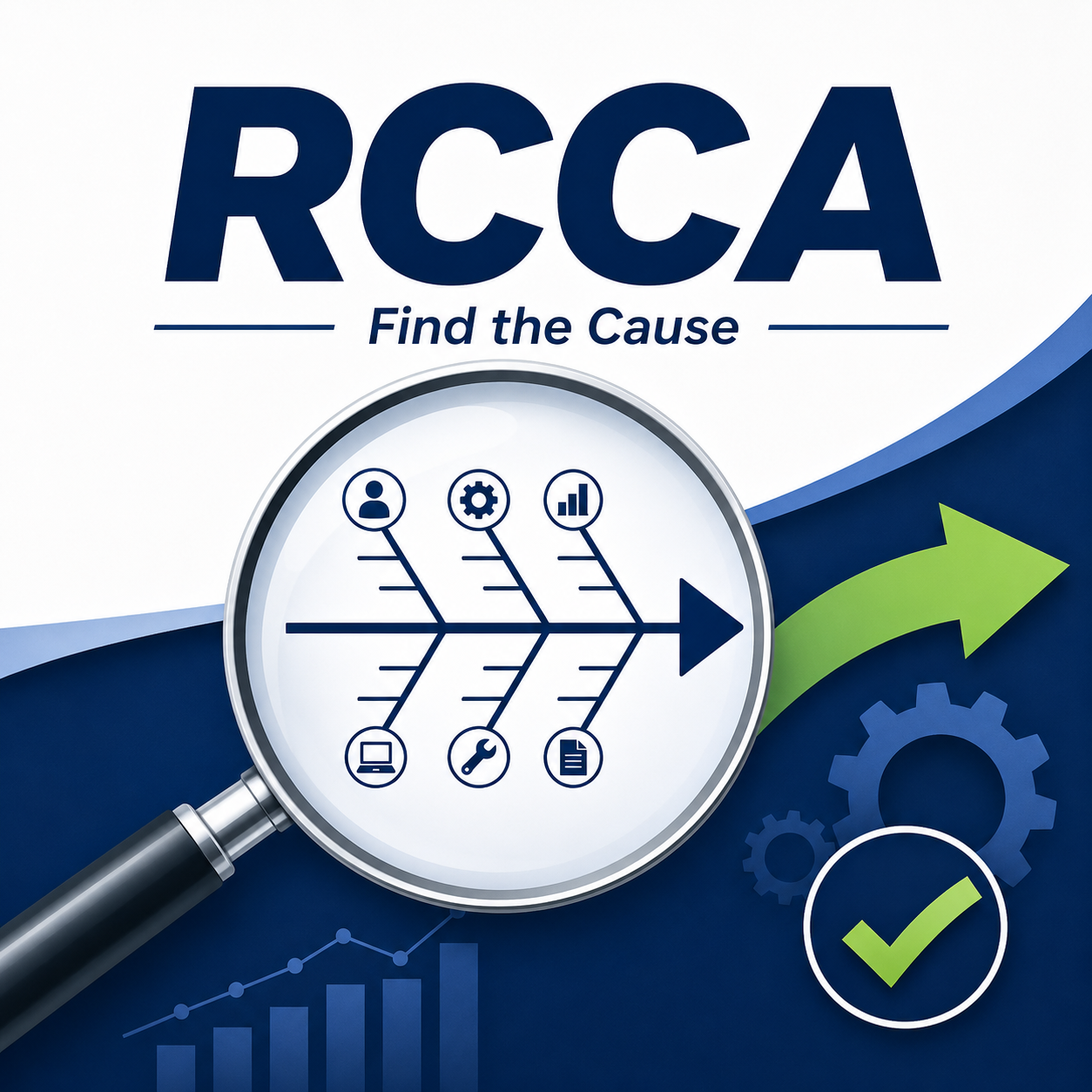 Why do quality problems keep recurring even after corrective actions have been taken? Why do teams sometimes struggle to identify the real causes of defects, variation and process inefficiencies despite having large amounts of operational data?
LEARNING OUTCOMES
√ Understand the purpose and application of the 7 QC Tools in quality control and process improvement.
√ Explain how data variation affects product and process quality.
√ Apply a structured problem-solving approach to identify and resolve quality issues.
√ Construct and interpret Histograms to analyse data distribution and variation.
√ Apply Pareto Charts to prioritise significant problems using the 80/20 principle.
√ Develop effective Check Sheets for systematic data collection and analysis.
√ Use Scatter Diagrams to identify relationships between variables.
√ Apply Control Charts (X̄-R, c and p Charts) to monitor process stability and detect abnormalities.
√ Use Stratification to separate and analyse data for clearer problem identification.
√ Develop and interpret Fishbone / Ishikawa Diagrams to identify potential root causes.
√ Apply the 8 Rules for Action to recognise out-of-control process conditions.
√ Integrate the 7 QC Tools with PDCA to support continuous quality and process improvement.
WHO SHOULD ATTEND?
This program is suitable for Managers, Executives, Supervisors, Engineers, QA/QC Personnel, Production Personnel, Maintenance Personnel, Process Owners, Technical Personnel, Customer Complaint Teams, Continuous Improvement Teams and employees responsible for investigating problems, nonconformities, failures or corrective actions.
COURSE BENEFITS
This programme helps organisations strengthen their problem-solving discipline by enabling employees to move beyond quick fixes and identify verified root causes. Participants will be better equipped to reduce recurring defects, failures and complaints, develop more effective corrective actions, improve process reliability and support continual improvement across the organisation.
TRAINING METHODOLOGY
This workshop adopts a practical and participative approach, combining trainer explanation, workplace case studies, guided discussion, data-analysis exercises, Root Cause Analysis tools, group problem-solving activities and corrective-action planning. Participants will progressively apply RCCA techniques to realistic workplace problems and develop practical actions that can be transferred directly to their own work environment.
TRAINING DURATION
Full 2 day training (9:00 am – 5:00 pm)
PUBLIC PROGRAM COURSE FEE
Single Registration – RM 1480.00 nett per participant
Group Registration – RM 1,100.00 nett per participant
(Minimum 4 participants from the same organisation)
(The fee covers training materials, supplementary notes, a detailed training report with assessment and a Certificate of Completion)
IN-HOUSE TRAINING ENQUIRY
For more information regarding our In-House/ Public Program courses, please email us your inquiry at [email protected]
or to speak to our Sales Consultant at + 604- 297 6881 or 011-1289 6881.
For public program schedules, please visit our website: www.progresslink.com.my
Register with us today! Training fees are eligible for claims under the HRD Corp Claimable Courses scheme.
REGISTER ONLINE

Sorry, the comment form is closed at this time.